go to WASHINGTON FREE PRESS HOME
(subscribe, contacts, archives, latest, etc.)
May/June 1999 issue (#39)
Norman Solomon vs. The Propaganda System
Interview by Greg Bates
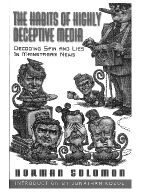
Greg Bates:Fewer than ten companies control virtually most of the market.... But now, with the Internet, anyone can put up a Web page for a few hundred bucks. Is this going to put an end to the media's grip on information and democratize the industry?
Norman Solomon: Well, this has been going on for most of this century, back from the 1920s.... [Technology] was going to, we were told, democratize the society, or at least be a force in that direction.... [But] we have this multiplicity of illusions of choice and actually those choices are narrowing in the sense that we have fewer and fewer substantive varieties to choose from. I mean, you can't walk down the street and choose to buy a daily newspaper that is owned by the people who work at it. It's just not in the range of options.... I was on an airplane a couple of weeks ago, picked up the airline magazine, and there was a full-page ad with a picture of Tom Brokaw, and it said, "NBC Nightly News with Tom Brokaw. Monday through Friday. It's all you need to know." ... What is being communicated to us ... is that you just stick with the corporate program, literally and figuratively, and we'll tell you all you need to know.... That's a very dangerous assumption.
GB: Right after the Watergate scandal broke, there were tons of people who wanted to be the next Woodward and Bernstein.... But now, according to polls, journalists are trusted less than lawyers, politicians and used car salesman.
NS: There's been a backlash against the Watergate-era type of investigation.... But I think we also should recognize that the Watergate scandal was about a split between elites. The Democrat and Republican parties were in a conflict and it's in those situations, where you have big vested interests at war with each other ... that you're apt to have the most pervasive and ongoing, in-depth media investigations. [In] the Iran-Contra scandal ... the victims were thousands of massacred peasants in Central America who were victims of U.S. foreign policy, and the Iran-contra scandal was not sustained as an investigative, in-depth push by the media.... That's significant because ultimately most scandal coverage is only stenography for the powerful and journalists, although they may shake the story loose, are not going to be moving that far ahead of the Justice Department and members of Congress....
GB: In this morning's Boston Globe, there's coverage of a U.N. report on a genocidal campaign in Guatemala, and the report claims that, "The U.S. knew perfectly well what was going on. It raised no objection and it continued its support for the Guatemalan army." Indeed, the U.S. even provided one and a half million dollars for the U.N. investigation.... In light of that, what more could we want?
NS: Here we are in 1999 and we're reading about atrocities that were backed, funded and supported by the U.S. government during the 1970s and 1980s. As Napoleon said, it's not necessary to censor the news. It's sufficient to delay it until it no longer matters.... Even this coverage, in the early spring of 1999, has come not because of digging and investigative reporting and courage per se by major U.S. media institutions. They're reporting on an official commission report that was convened by the government.... This is stenography.... The major threat is about corporate domination, where huge concentrations of capital are, so to speak, sitting on the windpipe of the First Amendment, so that it exists in theory, on paper, and it's a legal guarantee of sorts, but in practice it's not able to resuscitate itself.... The First Amendment per se guarantees freedom of speech, but it does not guarantee freedom to be heard. It definitely does not guarantee freedom to be heard widely....
Anybody can put up a web page. But if you look at the fifteen most widely visited web sites in the spring of 1999 on the World Wide Web, fourteen out of the fifteen are owned now by huge corporations. And the most recent transition from independent to conglomerate-owned came just weeks ago in February of 1999 when USA Networks Inc. bought the Lycos conglomerative sites to form a twenty-billion-dollar company.... Nothing I'm saying is to imply that we should hang back from trying to make maximum independent progressive grassroots use of the internet. But I think we need to go in with our eyes open and get the cyberstars out of our eyes....
In this time, when language is often subject to ... Orwellian euphemisms and beating around the bush, to speak clearly about corporate power is a radical action. It's not sufficient, but it's a necessary precondition for the kind of changes that I think we can create.
GB: You gave the example in your book of an article that was critical of Nike which was axed by the San Francisco Examiner because the newspaper was co-sponsoring a sporting event with Nike.... Do you see this trend intensifying, or is it sort of business as usual?
NS: Well, I think it's routine and the most pernicious is really what we don't hear about at all, which is when there's not even an attempt made to report on something. There's a celebrated example of two reporters at the Fox network ... who were reporting on some of the negative effects of chemical additives in food and Monsanto went ballistic and the Fox hierarchy pulled the plug on those reporters. You have the terrible situation in Cincinnati ... when a reporter raised issues of malfeasance by [Chiquita] in collusion with the very destructive and deadly political forces in Central America.... The reporter was basically crucified. The story was retracted. The newspaper paid out millions of dollars and publicly, figuratively speaking, crawled on its hands and knees begging for the forgiveness of Chiquita.... But you know, the negative veto and the positive veto really work hand in hand.... What was supposed to be the separation between ... advertising and editorial departments ... once that wall is overtly breached, then the power of the positive veto is enhanced and also the power of the negative veto is jacked up.... To take the internet example again, while it's important that we have the freedom to use the internet for independent purposes, when you pour billions of dollars of cross-promotion.... You have just a powerful economic engine. And so they don't really need to stifle the First Amendment. They can just gradually suck the oxygen out by using so much of the space themselves.
GB: One of the maybe most startling facts in [your] book for me was the point that thirty million Americans are hungry.... I find myself asking, How come I didn't know this? ... I wonder what other omissions of the media have struck you as most profound.
NS: Well, I think the fact that for instance the aggregate wealth of the average American family is actually lower now than it was ten years ago, that essentially a third of the people who have lost their full-time jobs haven't gotten them back in the last few years.
That a large number of people who are part of the working poor don' t have health care, health coverage, and that one out of five children in this country is born below the poverty line in 1999. These aren't secrets, and our society doesn't function per se through one hundred percent censorship or through simply banning information. It simply is not part of the propaganda system to repeat and widely disseminate this information.... Any propagandist understands that the essence of propaganda is repetition.... [They're] almost literally drowning out these other bits of information which are not favored on the part of the major media....
It's fair to say that there's a basic message around economic reporting, and that is something like this: When rich people get richer, that's really wonderful. When other people have an increase in their income, that's probably good, but you have to be wary about the down-sides for the economy.... When the stock market goes through the roof, that is reported as an unmitigated good, and the only major concern is whether it 's a bubble that will pop.
Contrast that to what happens when there's a report that wages have risen.... There's all kinds of concern.... Is it going to fuel inflation? When there's reporting that wages are flat ... the stock market spikes upward. So the media mythos is that we all gain when "the economy" is doing well.... The contradiction in fact shows that ... the owners and the workers have basically different interests. And that is heresy in the mass media.
GB: And you get the picture that maybe we'll get to the level where stock ownership can kind of compensate for the wage gap.
NS: Well, [the increasing involvement of the little guy in the world of stocks] is really being propagated in the mass media.... "What's the Dow doing at this moment?" The myth that it's predicated on is that most people are playing the stock market. And that's not the case.... You've got a very small percentage ... ten to twenty percent, perhaps, that really have any substantive investment in the stock market.... It's kind of like the scratch-off lotto at your convenience store.... Capitalism is a great game. Anybody can play. But as in most games, there are some winners and there are some losers....
GB: Many years ago, I think there were few media critics, but now I see there's this new magazine called Brill's Content.... And some would say ... your profession, such as it is, has gone mainstream.... But, I get a sense that you're not content. Why?
NS: One of the great creative capacities of the corporate media system is to put forward ostensibly critical alternatives that are pretty much in line with existing corporate assumptions, and media criticism is no exception. It's no secret that many people are alienated from mass media. There's a market for something that will seem like and taste like and smell like media criticism. But these are in-house critics, who are, with very few exceptions, pretty obedient and pretty domesticated.... Barry Diller, the man who owns USA Networks, Inc., [and] who founded the Home Shopping Channels [is] one of the four owners now of Brill's Content, [which] is going to critically examine mass media....
Another example would be that NewsHour with Jim Lehrer has now gotten a multimillion dollar contract to do media criticism. Terence Smith, a former network correspondent, now does these ponderous roundtables ... [where] brings in mostly media insiders not to critique corporate media in its essence as to who's paying the piper and whose interests are being served, but to nibble around those edges in the kind of erudite way that media professionals love to do when it won't rock any of the big boats that they're riding in.... I'm not only skeptical of the prevailing "media criticism," I see it as actually just part of the propaganda system.
Thanks to Chris Winters for editing.
go to WASHINGTON FREE PRESS HOME
(subscribe, contacts, archives, etc.)