go to WASHINGTON FREE PRESS HOME
(subscribe, contacts, archives, latest, etc.)
May/June 1999 issue (#39)
Kiss Your Gas Good-bye
The UW's Richard Gammon gives the word on global warming
By Renee Kjartan, Free Press Contributor
"We're on a one-way trip. The data is all there. We're going out there and we're not coming back," said Professor Richard Gammon, noting that the Earth already has heated by about one degree Fahrenheit in the last century, and that it will not cool down to "normal" again. A change of just a few degrees in temperature can cause extreme changes in climate. The main cause of the climate change is the buildup of carbon dioxide (CO2) in the atmosphere. The source is the combustion of fossil fuels--principally coal, oil, and gas. The burning of fossil fuels is committing the world to climate change "for tens of thousands of years," Gammon said. The "normal" amount of CO2 in the atmosphere he sets at 280 parts per million, the level that was present before the Industrial Revolution. Today, the CO2 level has reached 365 ppm, "a level not experienced by the Earth since before the dawn of our species 100,000 years ago," Gammon said.
Some of the early consequences of global warming already threaten us. The Earth is warming up more at night than during the day; and to a greater degree the further the latitude from the equator. At 560 ppm of CO2, the Pacific Northwest will have warmed to the point where the average temperature equals that of areas some 500 miles south. Thus, Puget Sound's climate would look like that of southern Oregon. This could raise the Earth's temperature by some 7 degrees F, and could occur within 50 to 70 years, he said, "assuming the present rate of emissions does not change."
Gammon has been on the faculty of the University of Washington since 1977, is active in international conferences on climate change, and speaks frequently to the public on the subject. He is professor of chemistry and oceanography and adjunct professor of atmospheric sciences and is also a senior fellow at the university's Joint Institute for the Study of Atmosphere and Oceans. He was a co-author of the 1990 Scientific Assessment by the Intergovernmental Panel on Climate Change (IPCC, a United Nations advisory body), and previously directed the United States program to globally monitor the atmospheric concentration of CO2.
We're Number One
Normally, when the sun's rays reach the Earth, some of this light is reflected back into space, while most warms the Earth. If this "natural greenhouse effect" did not happen, the Earth's temperature would be far below freezing. Due to the combustion of fossil fuels, which are "potent greenhouse gases," the temperature of the planet is now rising beyond what is normal. Humans worldwide are burning more than 6 billion metric tons of fossil carbon per year-about one ton per person per year, but the average in the U.S. is 5 tons per person per year, making this country responsible for more than 20 percent of the global total emissions, even though we comprise only 4 percent of the world's population.
Moreover, a gallon of gasoline emits 18 pounds of CO2, even though the gallon weighs only five pounds. He explained: "Mass is conserved in chemical reactions: five pounds of gasoline (about five pounds of carbon) comes out the tailpipe as five pounds of carbon, but now chemically combined with thirteen pounds of atmospheric oxygen in the combustion product CO2.
Adding to the problem, CO2 circulates in the ocean, atmosphere, and land biosphere for up to a few thousand years. During this period, time and again, the carbon is absorbed and released by the oceans in reaction with calcium carbonate, or by plants in photosynthesis. "But this does not put it safely back deep underground. The carbon can only go back underground as coal or oil at the rate the plants put it there--and this takes millions of years!"
Coal is the worst fossil fuel for CO2 emissions because coal is pure carbon. Natural gas is the least dirty of the fuels, producing about half the carbon dioxide per unit of energy produced as compared with coal, Gammon said.
One much discussed future consequence of global warming is the disappearance of the polar icecaps. Temperate-latitude glaciers and snowcaps already are melting, and Greenland's icecaps are receding. The oceans have already risen by some 6 inches in the last century, partly due to warming of the water and glacial melting. An increase in the Earth's temperature of only several degrees C could result in a sea- level rise of up to 3 feet within the next century. Many lowland beaches, wetlands, and coastal areas could disappear. The Association of Small Island States has already charged before the United Nations that genocide is being perpetrated on them, because their lands are beginning to disappear as the seas rise.
Also, the Gulf Stream's warm and salty waters normally cool and sink off Iceland, a process that releases heat and moderates the climate of much of the eastern United States and northern Europe. Gammon said these waters could freshen, primarily due to increased rainfall, to the point where the deep convection action could cease. "One climate model has the Gulf Stream slowing significantly by doubled CO2. Another model puts the shut-off at quadrupled CO2. The climate in Europe could then sink into an extremely cold weather pattern; or Europe's temperature could flicker, alternating between extreme heat and cold on a decadal time scale."
The developing nations would "feel the heat" the most. The animals and crops in these subtropical areas are already close to the edge of their heat tolerance and these areas lack the infrastructure and technology to cope with rapid climate change. The world could see millions of "climate refugees" fleeing to "developed, mid-latitude countries with more diversified energy and agricultural systems."
So what do we do?
In 1988 the United Nations formed the Intergovernmental Panel on Climate Change (IPCC). Its mission was to assess information on climate change and to formulate response strategies. The IPCC issued its first report in 1990, with Gammon co-authoring the chapter on the carbon cycle. This work formed the scientific basis for the worldwide Earth Summit, held in 1992 in Rio de Janeiro. Over 100 national leaders attended this conference, where a treaty was signed calling for reductions in the emissions of greenhouse gases in order to avert global warming. The U.S. insisted on scaling back the treaty, however, and refused to sign another pact that called for protecting endangered species and their habitats.
The IPCC issued its second assessment report in 1995. (Documents are at the United Nations Environment Program Web site, www.unep.org; hardcopy by Cambridge University Press.) The IPCC stated that between 50 and 75 percent of projected future emissions produced by burning fossil fuels must be eliminated by 2050 to prevent a doubling or even tripling of greenhouse gases late in the 21st century. The IPCC will issue its third assessment report in about a year.
At Kyoto, Japan, in 1997, as a follow-up to the Rio Earth Summit, representatives of essentially all the countries of the world accepted the IPCC's 1995 report as a basis for the global policy response. The representatives stated that the most important goal is to reduce CO2 emissions as quickly as possible and to implement energy conservation and efficiency measures. The U.S., this time with Japan, fought to weaken standards for emission reductions. In the end, the Kyoto Protocol called for 38 industrialized nations to reduce their emissions by some 5.2 percent below 1990 levels by 2012. The U.S agreed to a 7 percent cut below 1990 levels-although it now exceeds 1990 emission levels by about 10 percent! The next world meeting on climate change will be held in Bonn, Germany, in late October.
"The acceptance of the inescapable seriousness of this problem by essentially all governments of the world, except the USA," said Gammon, when asked to name some positive steps that have been taken since the Rio meeting, adding, "the formulation of the Kyoto Protocol as the first step in moving the world away from fossil fuels as the primary energy source; the advances of the clean energy industries--especially solar, fuel cells, and wind, especially in Europe and Japan; the strong positions that global warming does exist and must be taken seriously by Shell and BP; and the position by the global reinsurance industry that climate change represents a threat and an opportunity."
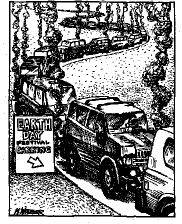
As for negative developments, he notes the U.S. government's failure to address the problem, low gas prices and the high number of gas-guzzling sport utility vehicles in the U.S., climate effects like Hurricane Mitch and El Nino, "and the success of the misinformation and lobbying efforts of the petroleum-industry sponsored Global Climate Coalition."
Gammon said people should learn about global warming and then get politically active. He endorsed the Rio Framework Convention on Climate Change which stated that the "stabilization of greenhouse gas concentrations in the atmosphere must be achieved within a timeframe sufficient to allow ecosystems to adapt naturally to climate change to ensure that food production is not threatened and to enable economic development to proceed in a sustainable manner." He added that this stabilization "will require absolute reductions in CO2 emissions of 60-80 percent (and more in the developed countries). This means the abandonment of fossil fuels as the world energy source, and this transition must be accomplished within the next 30-50 years."
To get involved, contact the Atmosphere Alliance, publishers of Earth Island News, for a free copy of "How the Northwest Can Lead a Clean Energy Revolution." 2103 Harrison Ave. NW, #2615, Olympia, WA 98502; atmosphere@olywa.net
go to WASHINGTON FREE PRESS HOME
(subscribe, contacts, archives, etc.)