go to WASHINGTON FREE PRESS HOME
(subscribe, contacts, archives, latest, etc.)
May/June 1999 issue (#39)

by Kent Chadwick
Democrats of the World Unite!
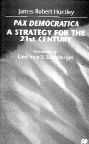 Pax Democratica:
A Strategy for the 21st Century
by James Robert Huntley
St. Martin's Press, 1998
243 pages, hardcover
 he United States at its founding was a revolutionary power. Its liberal democracy was an entirely new political system that ruptured the millennial-old sway of monarchism. The United States' example encouraged 18th and 19th century revolutionaries in France, Belgium, Poland, Geneva, Russia, and all through South America. Its founding documents remain great proclamations of democratic values, having inspired the Declaration of the Rights of Man (1789), national constitutions across the world, the Universal Declaration of Human Rights (1948), and today's democratic activists from China to Burma to Nigeria.
But as we became an imperial power, United States governments chose to suppress movements for democratic self-determination in our acquired colonies. In one of our most notorious efforts, the U.S. military overthrew the nascent Philippine Republic in 1899 and fought a brutal 15-year war against regular and guerrilla Filipino forces that required over 75,000 U.S. soldiers and resulted in over 200,000 Filipino deaths.
This governmental split personality, a deep belief in democratic values contradicted by a willingness to crush fledgling democracies when it served geopolitical or economic ends, became acute in our postwar rise to superpower status. U.S. administrations spent billions to recreate enemies -- Germany and Japan -- in our own image as liberal, capitalist democracies, and succeeded dramatically to the great satisfaction of Germans, Japanese, and their neighbors. Yet because of fear of the Soviet Union, U.S. governments also became pathologically suspicious of democracy at home and abroad, destroyed democratic governments in Iran (1953), Guatemala (1954), and Chile (1973), supported dictators around the world, and committed crimes against domestic democratic movements.
Ironically, it was even more the appeal of democratic values and pluralistic cultures than the might of the U.S.'s military containment policy that finally toppled the Soviet empire.
Now in the post-Cold War period when the United States is the one "essential nation," we have the chance to renew our inheritance and do something revolutionary again. Instead of compulsively expanding a Pax Americana through military interventions at the peripheries of our control, as in Kosovo, we could help inaugurate a new era in which a concert of democracies begins to replace national interests with common interests in order to build a Pax Democratica.
In a democratic world peace, mature democracies would continue their historic tendency of not warring amongst themselves. They would politically and economically favor other democratic nations and distance themselves from authoritarian regimes. They would actively promote the establishment of new democratic governments through democratic means: aid, education, social and cultural contacts, moral suasion, coalition building, and mutual security arrangements. They would work to strengthen new democracies, even at the expense of their short-term interests. Recognizing that every democracy is a work-in-progress, they would work continually to improve their own democratic institutions. They would create an intercontinental community of democracies with a democratic caucus at the United Nations, a parliamentary assembly of democracies, and a court of the democracies for human rights. Following the lead of the European Union, the democracies would join together in an economic and military union.
This is the vision of James Robert Huntley's book Pax Democratica: A Strategy for the 21st Century. "Democrats everywhere," he writes, "should regard it as their first duty to help extend the realm of democracy in the world, as the best insurance that eventually, at some unknowable time in the future, both democide [a term coined by R. J. Rummel to encompass both genocide and mass murders of diverse populations] and wars will become relics of a gloomy past."
Huntley is no Thomas Paine. His book is not a stirring clarion call to the cause of international democracy. The Common Sense of the international democratic movement remains to be written. What Huntley has accomplished is to introduce a compelling new internationalist vision and present a well-reasoned argument for its acceptance in the language used by foreign policy decision-makers. He was well-suited for that task with professional experience as an American diplomat assigned to a variety of European countries and organizations, as an international affairs scholar who founded a number of Atlantic alliance study groups, and as a consultant to international corporations such as Battelle, Exxon, and IBM. Though now retired and living on Bainbridge Island, Huntley's past professional connections (former Secretary of State Lawrence Eagleburger contributed a foreword to the book) should ensure that his ideas get a full hearing in governmental circles. There were indications of just that when Secretary of State Madeleine Albright mentioned in a January 1999 interview with the Los Angeles Times that the State Department had begun to plan for the founding of a new organization of democratic states.
Huntley's political perspective is that of a Hubert Humphrey-styled Democrat, a Happy Cold Warrior with an international vision. But by distinguishing democracy from capitalism and then concentrating primarily on international structural issues, not economic ones, Huntley's vision is one that should be debated and could be embraced by both the democratic left and right.
Huntley builds his argument for an intercontinental community of democracies on the post-war experience of the United States and Europe. He believes that "the European Union is the greatest political invention of the 20th century, even though the process is not complete." In his political taxonomy the European Union, as a supranational political community, is a fourth phase institution. Empires are the first phase of international organization, in Huntley's terms. Balance of power systems sustained between nation-states following the realpolitik policies of a Metternich or Kissinger represent a second phase. Intergovernmental organizations like the United Nations are third phase institutions. In the fourth phase, like-minded democracies join together in institutions that operate on the basis of international federalism, where specified policies are decided democratically, not at a national level but at a supranational one. One fourth phase institution that Huntley proposes is a Court of the Democracies for Human Rights, which could be an expansion of the existing European Court of Human Rights, where "citizens of member countries are enabled to appeal decisions of their national courts for alleged violation of their human rights."
Pax Democratica: A Strategy for the 21st Century concludes with concrete proposals for a complete international federalist system that Huntley acknowledges should just be a starting point for vigorous, worldwide debate. My initial rebuttals include objections to the non-democratic nature of the Democracies Planning Group that Huntley suggests would serve as the fourth phase's "operational hands and feet," and to his low evaluation of the state of democracy in India and the limited role he envisions for that county. But I believe that Huntley's overall vision of an international community of democracies is the best foreign policy strategy imaginable for America to pursue in the next century.
Kent Chadwick will be reading at the Jack Straw Foundation as part of its 1999 Writers Program on May 14th at 8 p.m.
go to WASHINGTON FREE PRESS HOME
(subscribe, contacts, archives, etc.)