go to WASHINGTON FREE PRESS HOME
(subscribe, contacts, archives, latest, etc.)
March/April 1999 issue (#38)
 Hits You Where You Live
by Tara Herivel, Free Press contributor
 hen Daria first visited the tree-shrouded Lake City rooming house, she thought it would be a livable rental for the time being. With a shortage of cheap rentals in Seattle, Daria couldn't afford to be picky. Though there were holes in the wall, bare sheet rock walls, and drafty gaps in the molding, the landlord assured her repairs were his first order of business. Daria moved in, with no idea what lay in store for her in the house she soon came to call "Little Apalachia."
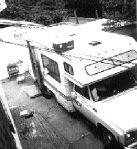
Daria soon discovered the tenancy accommodated seven more people than stated by the landlord. The landlord ( who remains unnamed because of Daria's fear of retaliation) lived in an RV on the property. The landlord's brother and his wife were sleeping on a hideaway couch in the yard, their pitched fights broadcasting across the neighborhood. Two people lived in the garage, and the landlord was building questionably crafted additions for another two tenants. Seven people actually lived in the house. But this was just the beginning.
Daria discovered she couldn't use the bathroom without fear for her personal safety. Because the only entrance to the shared bathroom was through her neighbor's room, he insisted she schedule her use with him. Often, her neighbor wouldn't allow her passage, or, he would scream profanities and threats at her just for asking.
With walls thin and rickety as parchment, and covered with gaping holes, Daria got to know her surly neighbor's habits well. Nearly every night, she would hear a "popping sound"coming from the bathroom, followed by screams and an acrid stench. Daria soon deduced that her mood-swinging neighbor was a junkie. In fact, lots of people in "Little Apalachia" were junkies. Daria discovered drugs were frequently traded for rent. Her room was raided for the exciting looking blue pills she took as part of a medical study.
Daria's breaking point came when she realized the clicking sound on her phone was the landlord tapping into her line. Daria discovered that the landlord could not procure his own line, having run up a hefty balance with the "sex lines" that he ran several years back. Instead of paying his bill, he spliced into his tenants' lines, running up bills on their tabs.
An adept activist, Daria contacted the Department of Construction and Labor, the City's department in charge of regulating the housing code and administering building permits. The agency told Daria hers was the worst case they'd heard of, and promised to take action. Months have passed, and now they won't even return her phone calls. For her predicament of poverty, Daria received little attention and even less remedy.
Daria left the house less than a month later, defeated by a nightmarish renting experience and an apathetic web of city agencies. She thinks her ex-landlord is stalking her, and has seen him parked in front of her new home. She fears that he will harm her in retaliation for filing complaints against him with the police. Emotionally scarred by the experience, she has frequent nightmares about "Little Apalachia."
Bizarre as Daria's story is, it's merely an example of the unchecked power of Seattle landlords, who may hike rents, exploit tenants, or maintain unlivable conditions, suffering nary a slap on the wrist by the City for their abuses.
Gavin Morgan's experience as an abused tenant fared a bit better in the end than Daria's. A resident at the Qualman Apartments on First Hill, the building changed ownership and Gavin and his neighbors received one month's notice of rental increases ranging between 20-50%. Gavin is an activist with a background in gay activism and international human rights. He organized immediately with other tenants to form the Qualman Tenants Coalition. "When this first happened, we couldn't believe [the rent increases] were legal." The group contacted the Tenants Union, who informed them that though such outrageous rent increases were legal, they could help the group form a course of action. The Tenants Union sent community organizer Scott Winn to help them construct a plan for effective protest.
The Coalition's first action was to stage a press conference. With management company Tecton, the new owners of the building, Daley and Sommerville, and Qualman tenants present, the Coalition gained media visibility for their fight. Soon after, the tenants picketed the Qualman, again with media coverage. Over the next month, many tenants would move out because of the rent increase, but several who stayed chose to rent strike. Following Mayor Schell's proposal that landlords voluntarily cap rent increases at 10%, most strikers paid rent plus a 10% increase. The few tenants who stayed on at the Qualman and continued to rent strike were not evicted.
The tenants at the Qualman were better positioned than many to fight the antics of greedy landlords, antics most renters in Seattle have experienced as Seattle booms, and booms. As a group of young activists with energy and resources, the Qualman renters were prepared to fight. "They fucked with the wrong people," said Gavin Morgan. But vulnerable populations like the elderly, developmentally disabled, and non-English speaking peoples often are easy targets for landlords. Folks like Daria, who battle landlords' exploitative actions alone, are also more vulnerable because of a lack of support.
There is a glimmer of hope on the horizon. The City Council's Housing Committee extended rent increase notifications to 60 days from the previous 30 day notification requirement. And this past month Seattle Representative Velma Veloria led a series of discussions in Olympia about remedies for skyrocketing rents. The group of Western Washington Representatives considered a repeal of the current Washington ban on rent control. Proposals made by community activists like Judy Nicastro included a rent stabilization scheme that would cap rent increases per year at 8 or 9 %. The discussion seems hopeful, though a repeal of the ban will take time, if it is to happen at all. And the power of landlords in lobbying against such proposals has proven formidable in the past.
As Seattle prospers, the very populations that make Seattle a dynamic, and interesting place to live are rapidly being pushed out of Seattle city limits. The impact of wealth on Seattle will create a colorless town of yuppies, if we are willing to allow it.
go to WASHINGTON FREE PRESS HOME
(subscribe, contacts, archives, latest, etc.)