go to WASHINGTON FREE PRESS HOME
(subscribe, contacts, archives, latest, etc.)
Nov/Dec 1998 issue (#36)
Designing with Native Plants
For a low-maintenance natural garden, the secret is in the mix
by Charles Anderson, Free Press contributor
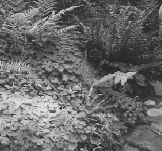
 lanting groups of plants that grow well together, and have for centuries, is the foundation for the successful use of native plants in the landscape. (Native plants, for the purpose of this article, are defined as plants that existed in any given area prior to occupation by Europeans.) Native plants can fulfill all of the usual functions of landscape plantings: massing, boundary, and visual interest. Water, nutrient, and light requirements for each species will be met more readily if they are grouped in their naturally occurring communities.
The plants will, to a certain extent, modify their immediate environment in a way that will benefit themselves and the other plants in the community. For example, our native sword fern, Polystichum munitum, grows in close association with our native big-leaf maple, Acer macrophyllum, benefiting from the weighty leaf litter and nutrient load the big tree drops every year, and well tolerating the drought soil conditions created by the maple's shallow and very thirst root system.
Choosing the plants that are right for your project requires a little sleuthing. You will need to go out and find a nearby natural area that has conditions that are as similar as possible to your site's. Look in natural portions of parks, arboreta, botanical gardens, nature preserves or reserves, game parks, and state and national parks or forests. Look for similar drainage patterns, similar exposure, similar vegetation; this is where the identity of the native plants on your site will come in particularly handy--if it's growing on your site, and growing in a natural area, then your site is similar to that natural area in at least some way.
Native plantings have the additional benefit of potentially requiring very little maintenance. In order to develop low-maintenance plantings, the designer and owner must allow the plant community or garden the freedom to express itself. This happens by planting in natural combinations and patterns that allow for the dominance of plants that are best adapted to the site conditions, yet that also allow less dominant plants to persist until site conditions change to meet their needs.
Thus, native plants that require shade can be planted in a exposed area, nestled under the shelter of a larger plant. Multiple layers of understory trees, shrubs, and groundcovers can be planted to the north of a small canopy tree, and will limit their self-establishment to the area that meets their requirements. As the tree grows and its canopy spreads, so will the environment that is appropriate for under-canopy plants.
Other methods of mixing plants will also provide a more adaptive and less maintenance-demanding landscape design, Mixtures of vigorous groundcovers will totally dominate the ground plane and will reduce the need for weeding or mulching. Plants that are dominant in early-successional situations will also reduce the need for weeding, and will eventually drop out of the mix as longer-lived plants dominated the planting. These plants, often the first ones to colonize a disturbed native landscape, differ from many in that they are adapted to growing quickly and breeding in large numbers in an open landscape with little competition, and will usually not withstand competition from perennials and woody plants.
As the landscape matures, woody plants and perennial grouncovers will fill in and cover the planting. At first glance these tactics might seem to promote a scruffy character. Plantings of this sort, however, will eventually settle into a pattern of lushness and visual diversity that is unmatched in any monotonous groundcover-and-shrub planting, and that is truly a lovely expression of the vigor and essential beauty of plants in their native environment.
You can always blend in non-native, non-invasive species of plants that you know and love while you wait for your native garden to settle in. Be careful however that these plants do not add to the mess of non-native plants that have been introduced here and have escaped into our wild areas causing very serious ecological damage. These plants include the likes of English Ivy, Cherry Laurel, Holly, and Himalayan Blackberry, to name a few.
Charles Anderson holds a Master degree of Landscape Architecture from Harvard University. He is a licensed Landscape Architect in California, Arizona, and Washington state and has been a lecturer at the University of Washington. Mr. Anderson has written a reference manual titled Native Plant Alliance, describing native plants for use in various urban settings in the Pacific Northwest. The manual may be obtained from Cascade Biomes at 206-322-0528.
go to WASHINGTON FREE PRESS HOME
(subscribe, contacts, archives, latest, etc.)