go to WASHINGTON FREE PRESS HOME
(subscribe, contacts, archives, latest, etc.)
Sept/Oct 1998 issue (#35)

by Kent Chadwick
Not an Epic, Thank You, But a Refreshing Novel in Verse
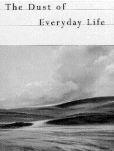 The Dust of Everyday Life: An Epic Poem of the Pacific Northwest
by Jana Harris
Sasquatch Books, 1997
Hard cover, 248 pages, $19.95
 ana Harris has written a beautiful long poem of great imagination, empathy, and detail. But whatever its subtitle may claim, The Dust of Everyday Life is not an epic poem. In fact, it's a disservice to Harris's actual accomplishments for Sasquatch Books to market it as such. And for what reason? Are epic poems selling more than novels these days?
Not every long poem is an epic. The Dust of Everyday Life is a novel in verse, an elegant kaleidoscope of letters, journal entries, first person reminiscences, meditations, and songs, which tell the life story of Helen Welch, a pioneer girl whose family has settled along the Oregon Trail in the 1860s.
Helen is not an epic hero; she is a smart girl living in the Umatilla desert of northeastern Oregon. She grows up observant, strong, and temperate -- temperate in joy, in grief, in wit, and in political cause. On her twelfth birthday she receives a diary and begins recording her careful observations:
"Wednesday: So cold cider vinegar
froze, shattering the jug. Our house
no longer in danger of being
carried away by vermin -- all fleas
and sand flies dead."
Helen's life is typical, not legendary. Harris, a creative writing teacher at the University of Washington, knows that we've had quite enough legendary white Western heroes. Her artistic attention has always been on ordinary lives, especially ordinary women's lives. She even titled one of her collections The Book of Common People: Poems in a Dime Store Sack. Her 1980 novel, Alaska, and her poetry book, Oh How Can I Keep on Singing?, both presented variegated stories of realistic pioneer life in the Northwest.
|
Ranks with Annie Dillard's The Living as historical fiction with contemporary sensibilities |
What makes Helen's story absorbing reading is not the plot but the craft in the telling. The Dust of Everyday Life compellingly blends the sensuous intensity of poetry with the character development of fiction. The 112 poems are organized into six books that carry Helen's story from her youth, through her school-teaching days in Granite City, Oregon and Minnesotan Tom Hodgson's courtship, to their married life in Olympia and their personal tragedies during the diphtheria epidemic of 1890. Helen's diary falls silent then, but her children and grandchildren add their voices and help continue the story through 1933 as they "walk in the shoes of their names," following or fighting the trajectories their family has launched them on.
Each poem gives stage to either Helen, a member of her family, or a close friend to write or speak their mind. This technique creates a multiplicity of "I's" refracting events and emotions into satisfyingly complex life portraits. Helen's first diary notice of the 'Sota Tom Hodgson is simply as a classmate. But it's her friend Belle Bishop who gets hold of her diary, while both are barricaded in Helen's house during a Paiute and Bannock raid, notes that Helen does not tell the diary everything, and writes her own entry about how Helen, on a dare, recently threw a rock at Tom, hitting him on his shoulder and winning his attention. Helen and Tom's romance is described with similar circumspection punctuated by the occasional revelation that adds a sweet suspense to their story.
In an otherwise perfectly crafted narrative, it was surprising, though, how Helen's younger sisters Bessie and Min completely disappear midway through the book without a hint to their fate.
Harris creates a leisurely rhythm in these poems akin to prose, which carries the narrative quite well across its many voices. However, she cuts this rhythm into lyric line lengths that are distracting. That's like taking a Black Forest cake and cutting it into bite-size pieces, then wrapping them in candy foil. Her line breaks work against her style and substance; whereas a longer blank verse line, the traditional workhorse of narrative poems, would have helped concentrate the undeniable power in her story.
Harris chooses her scenes with a keen sense of juxtaposition and understatement. She reveals a convincing knowledge of what frontier life was like, from "squeezing oil / from the livers of dogfish" to doctors opening up diphtheria-choked throats with fishhooks. She creates strong character profiles with a few dramatic details, and is equally as good at capturing the scents and feel of the land.
Here's an example as Helen's friend Belle recalls the time the whole town flooded, including her mother's hat shop:
"Water in my shoes, my legs
shivered. With Papa in heaven,
and my brother thinking
of getting married and no
good to anyone, who
would come to carry us out?
And what about Mrs. Brokenhorn?
I asked Mama if cows could swim.
Be good and happy
you live in these times,"
she said, holding her skirt
above the waterline,
'when we have trimmed hats to
wash away the dust of everyday life.'"
Sasquatch Books should take a page from Vikram Seth's success in the 1980s with The Golden Gate and repackage a second edition of The Dust of Everyday Life for what it truly is: a novel in verse that ranks with Annie Dillard's The Living as historical fiction with contemporary sensibilities.
go to WASHINGTON FREE PRESS HOME
(subscribe, contacts, archives, latest, etc.)